
Types of heavy construction equipments and their uses
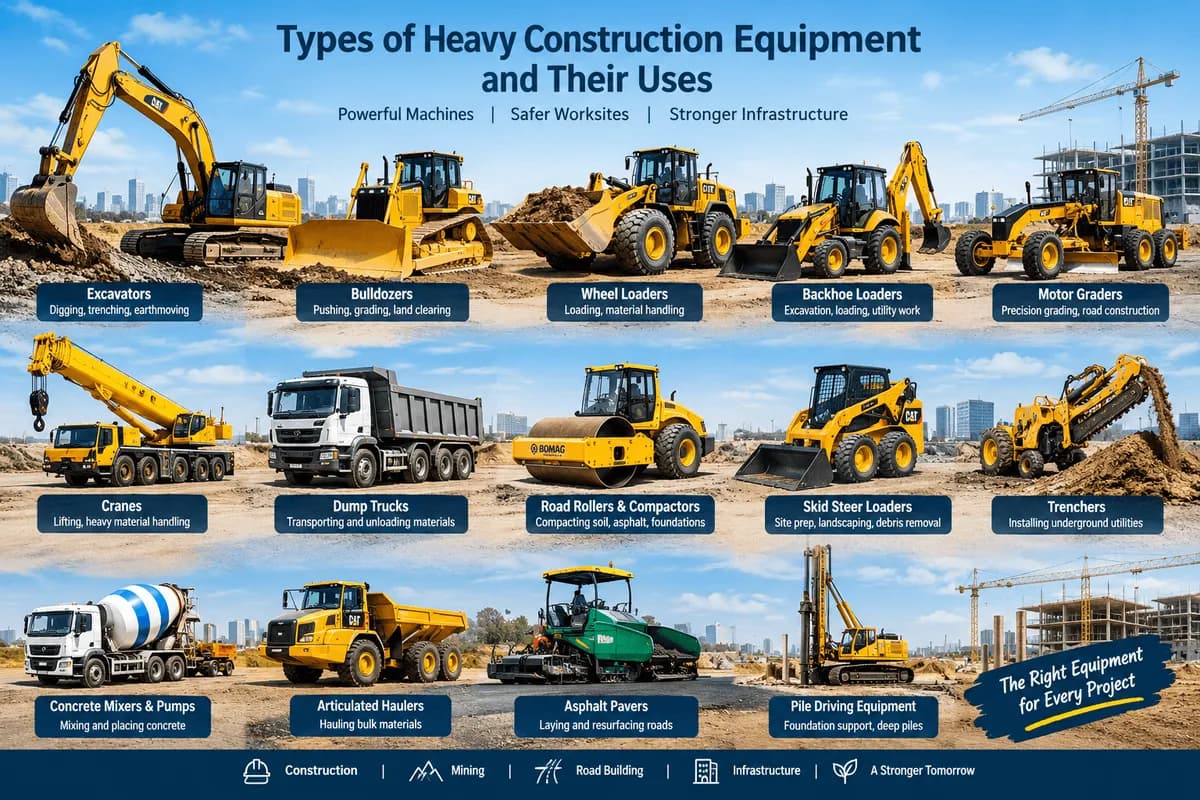
Discover the types of heavy construction equipment and their uses, including excavators, bulldozers, cranes, loaders, dump trucks, and road rollers.
Types of Heavy Construction Equipment and Their Uses
Heavy construction equipment plays a crucial role in modern construction, infrastructure development, road building, mining, and industrial projects. These powerful machines help contractors perform demanding tasks efficiently, reduce manual labor, improve productivity, and complete projects according to planned schedules. From excavators used for digging foundations to cranes designed for lifting heavy structural components, each type of heavy construction machinery serves a specific purpose.
Understanding the different types of heavy construction equipment and their uses helps construction companies, contractors, project managers, and equipment operators make informed decisions. Selecting the right machinery can improve operational efficiency, reduce project costs, and support safer working conditions.
In this guide, we explore the most common types of construction equipment, their applications, key benefits, maintenance requirements, and important factors to consider when choosing machinery for different construction projects.
What Is Heavy Construction Equipment?
Heavy construction equipment refers to large machines designed to perform demanding operations such as excavation, earthmoving, lifting, grading, material handling, transportation, compaction, and demolition. These machines are widely used in residential construction, commercial buildings, highways, bridges, mining operations, and infrastructure development.
Depending on their design and application, heavy equipment may operate on wheels, tracks, or specialized undercarriages. Some machines perform a specific task, while others support multiple applications through interchangeable attachments.
Common types of heavy construction machinery include:
- Excavators
- Bulldozers
- Wheel loaders
- Backhoe loaders
- Motor graders
- Mobile cranes and tower cranes
- Dump trucks and articulated haulers
- Road rollers and compactors
- Skid steer loaders
- Trenchers
- Concrete mixers and concrete pumps
- Asphalt pavers
- Pile driving equipment
1. Excavators
Excavators are among the most widely used types of heavy construction equipment. They are designed primarily for digging, trenching, earthmoving, foundation preparation, and material removal. A typical hydraulic excavator consists of a boom, arm, bucket, rotating cab, engine, and wheeled or tracked undercarriage.
Hydraulic excavators provide the digging force needed to remove soil, handle construction materials, and perform demanding excavation work. They are available in various sizes, ranging from compact mini excavators for restricted spaces to large machines used in mining and major infrastructure projects.
Common Uses of Excavators
- Digging foundations for residential and commercial buildings.
- Excavating trenches for water pipes, drainage systems, and electrical cables.
- Removing soil, rocks, and construction debris.
- Loading excavated material into dump trucks.
- Performing demolition work with suitable attachments.
- Preparing land for roads, buildings, and infrastructure projects.
Excavators can also use attachments such as hydraulic breakers, augers, grapples, and specialized buckets. These attachments expand their capabilities and make them suitable for different construction applications.
2. Bulldozers
Bulldozers are powerful construction machines equipped with a large metal blade at the front. They are primarily used to push soil, sand, gravel, rocks, and other materials across a construction site. Many bulldozers use tracks to provide traction and stability on uneven or soft terrain.
Common Uses of Bulldozers
- Clearing vegetation and debris from construction sites.
- Pushing and spreading large quantities of soil.
- Performing rough grading and land preparation.
- Creating embankments and construction access roads.
- Supporting mining, quarrying, and earthmoving operations.
- Preparing ground for road construction and building foundations.
Some bulldozers feature rear-mounted rippers that help break up compacted soil and certain rock formations. Their pushing power and ability to work in demanding conditions make them valuable for large earthmoving projects.
3. Wheel Loaders
Wheel loaders are heavy construction machines designed to scoop, lift, and move loose materials over relatively short distances. They typically feature a large front bucket and rubber tires that provide mobility on suitable surfaces.
These machines are particularly effective for loading materials into trucks and moving aggregates around construction sites. Their bucket capacity and operating weight vary according to the intended application.
Common Uses of Wheel Loaders
- Loading sand, gravel, and crushed stone into dump trucks.
- Moving soil and construction materials.
- Feeding crushers and screening equipment.
- Handling aggregates at quarries and material yards.
- Clearing debris and transporting loose materials.
- Supporting mining and infrastructure projects.
Wheel loaders are available in compact, medium, and large sizes. Choosing the appropriate model depends on material density, bucket capacity, ground conditions, travel distance, and loading requirements.
4. Backhoe Loaders
Backhoe loaders combine a front loader bucket with a rear digging arm. This dual-purpose design allows a single machine to perform excavation, loading, and material-handling tasks.
Backhoe loaders are commonly used in urban construction, utility maintenance, landscaping, and small infrastructure projects because they offer versatility without requiring multiple separate machines for every task.
Common Uses of Backhoe Loaders
- Digging small foundations and trenches.
- Installing underground utility lines.
- Loading soil and aggregates.
- Repairing roads and municipal infrastructure.
- Performing landscaping and site preparation.
- Removing small quantities of construction debris.
Their versatility makes backhoe loaders a practical choice for contractors who need a multipurpose machine for several activities across a project.
5. Motor Graders
Motor graders are specialized machines designed to create smooth, accurately graded surfaces. They typically have a long chassis and an adjustable blade positioned between the front and rear axles.
Unlike bulldozers, which primarily move large quantities of material, motor graders are used for more precise surface shaping. Accurate grading helps establish the required elevation, slope, and drainage profile.
Common Uses of Motor Graders
- Preparing road surfaces before paving.
- Maintaining gravel roads.
- Creating slopes and drainage profiles.
- Leveling construction sites.
- Shaping road shoulders and embankments.
- Supporting highway and airport construction.
Motor graders are essential for road construction and projects that require consistent surface levels and precise grading.
6. Cranes
Cranes are lifting machines used to raise, lower, and move heavy materials. They are essential for high-rise buildings, bridges, industrial facilities, steel structures, and infrastructure projects that require controlled lifting operations.
Types of Construction Cranes
- Mobile cranes: Mounted on wheeled vehicles or specialized carriers for transportation between suitable work locations.
- Tower cranes: Commonly used on high-rise construction projects where significant lifting height and horizontal reach are required.
- Crawler cranes: Mounted on tracks and used for heavy lifting on suitable prepared construction sites.
- Rough-terrain cranes: Designed for lifting operations in suitable off-road construction environments.
Common Uses of Cranes
- Lifting steel beams and structural components.
- Positioning precast concrete elements.
- Installing heavy industrial equipment.
- Moving materials to elevated building levels.
- Supporting bridge and infrastructure construction.
Crane selection requires consideration of load weight, lifting radius, boom configuration, ground conditions, wind conditions, and nearby obstacles. Qualified personnel must follow an appropriate lifting plan and applicable safety requirements.
7. Dump Trucks
Dump trucks are heavy-duty vehicles used to transport and unload bulk materials such as soil, sand, gravel, rock, and construction waste. Most models have a cargo bed that can be raised hydraulically to discharge materials efficiently.
Common Types of Dump Trucks
- Standard dump trucks: Used for transporting construction materials on suitable public roads and job sites.
- Articulated dump trucks: Designed to navigate suitable rough terrain using an articulated joint between the front and rear sections.
- Rigid-frame haul trucks: Large-capacity vehicles commonly used in mining and major earthmoving operations.
Common Uses of Dump Trucks
- Transporting excavated soil.
- Delivering sand, gravel, and aggregates.
- Removing demolition debris.
- Moving rock in quarrying operations.
- Supporting road construction and land development.
The correct truck depends on haul distance, material density, payload, terrain, site access, and the capacity of the loading equipment.
8. Road Rollers and Compactors
Road rollers and compactors increase the density of soil, asphalt, and other construction materials. Proper compaction improves stability, reduces excessive settlement, and helps create durable road surfaces and foundations.
Types of Compaction Equipment
- Smooth-drum rollers: Used for compacting suitable granular materials and asphalt.
- Padfoot rollers: Commonly used for compacting cohesive soils such as clay.
- Pneumatic-tire rollers: Apply pressure through rubber tires and are frequently used in asphalt paving operations.
- Vibratory rollers: Use vibration to improve compaction of suitable soils and aggregates.
Common Uses of Road Rollers
- Compacting road subgrades and base layers.
- Supporting asphalt paving operations.
- Preparing foundations and embankments.
- Compacting parking areas and industrial yards.
- Improving the stability of suitable fill materials.
The appropriate compactor depends on material type, moisture content, layer thickness, and required compaction standards. Correct equipment selection helps prevent weak surfaces and premature pavement failure.
9. Skid Steer Loaders
Skid steer loaders are compact, maneuverable construction machines designed for confined work areas. Their steering system allows tight turns, making them useful for residential construction, landscaping, renovation, and smaller commercial projects.
Many skid steer loaders support interchangeable attachments, including buckets, augers, trenchers, breakers, and grapples, provided the attachments are compatible with the machine.
Common Uses of Skid Steer Loaders
- Moving soil and loose construction materials.
- Cleaning and preparing construction sites.
- Performing light grading and landscaping.
- Removing debris and snow.
- Operating compatible hydraulic attachments.
Wheeled models are generally suitable for firm surfaces, while compact track loaders may provide improved traction and flotation on suitable soft ground.
10. Trenchers
Trenchers are specialized construction machines designed to excavate narrow, continuous trenches. They are particularly useful for installing underground utilities and infrastructure where consistent trench dimensions are required.
Common Uses of Trenchers
- Installing water pipelines.
- Laying electrical cables.
- Installing telecommunications and fiber-optic lines.
- Creating drainage trenches.
- Supporting irrigation systems.
Depending on the machine, trenchers may use a digging chain, toothed wheel, or another cutting mechanism. Underground utilities must be identified before excavation, and operators should follow applicable excavation safety procedures.
11. Concrete Mixers and Concrete Pumps
Concrete mixers and pumps are essential pieces of construction equipment used in building foundations, columns, beams, slabs, bridges, roads, and industrial structures.
Concrete mixers combine cement, water, sand, and aggregates to produce concrete according to the required mix design. Concrete pumps transport fresh concrete through pipes or hoses to the placement location.
Common Uses of Concrete Equipment
- Preparing concrete for foundations and floor slabs.
- Supplying concrete for columns and beams.
- Supporting road and pavement construction.
- Placing concrete on elevated floors.
- Delivering concrete to locations with restricted access.
Appropriate mix proportions, delivery timing, equipment capacity, and placement procedures are essential for maintaining concrete quality and minimizing material waste.
12. Articulated Haulers
Articulated haulers are heavy-duty vehicles designed to transport bulk materials across demanding construction terrain. Their articulated steering system allows the front and rear sections to pivot, improving maneuverability on suitable uneven access routes.
Common Uses of Articulated Haulers
- Transporting soil from excavation areas.
- Moving rock and aggregates at construction sites.
- Supporting large earthmoving projects.
- Hauling materials at quarries and mines.
- Transporting bulk materials across suitable rough terrain.
Payload capacity, traction, terrain, travel distance, and loading conditions should be considered when choosing an articulated hauler.
13. Asphalt Pavers
Asphalt pavers are specialized machines used to distribute and lay asphalt mixtures across prepared road surfaces. They form an important part of road construction and resurfacing operations.
Common Uses of Asphalt Pavers
- Constructing highways and major roads.
- Paving urban streets and residential roads.
- Building parking lots and access roads.
- Surfacing airport pavements.
- Repairing and resurfacing existing roads.
Pavers help achieve consistent material distribution and pavement thickness when operated correctly. Asphalt temperature, paving speed, material supply, and coordination with compaction equipment are important factors in producing quality pavement.
14. Pile Driving Equipment
Pile driving equipment is used to install piles into the ground to support structures where shallow foundations may not provide sufficient bearing capacity. Depending on the design, piles can transfer loads to deeper soil layers or competent rock.
Common Uses of Pile Driving Equipment
- Constructing foundations for bridges.
- Supporting high-rise buildings.
- Building docks and marine structures.
- Supporting industrial facilities.
- Constructing foundations in suitable weak-soil conditions.
Pile installation methods include impact driving, vibratory driving, and other specialized techniques. The appropriate method depends on soil conditions, pile material, environmental restrictions, and engineering requirements.
Benefits of Using Heavy Construction Equipment
Heavy construction machinery helps contractors perform complex operations with greater efficiency. When equipment is properly selected and operated, it can improve productivity and support better project management.
1. Increased Productivity
Heavy equipment can excavate, lift, transport, and compact large quantities of material more efficiently than manual methods. This can help construction teams meet project deadlines and manage demanding workloads.
2. Reduced Manual Labor
Mechanized construction reduces the need for workers to perform physically demanding tasks directly. Skilled operators, maintenance technicians, supervisors, and ground personnel remain important for safe and effective operations.
3. Improved Accuracy
Modern machinery may include grade-control systems, positioning technology, and digital monitoring tools that help operators achieve consistent elevations, dimensions, and working tolerances.
4. Greater Versatility
Machines equipped with compatible attachments can perform several tasks without requiring a separate machine for every operation. This versatility can be particularly beneficial for contractors managing different types of projects.
5. Better Project Efficiency
Matching machine capacity to project requirements can improve coordination between excavation, hauling, grading, material placement, and finishing activities.
6. Improved Safety When Properly Managed
Mechanization can reduce certain manual-handling risks, but heavy equipment introduces hazards such as blind spots, moving vehicles, suspended loads, and unstable ground. Operator training, inspections, clear communication, and suitable safety procedures are essential.
How to Choose the Right Heavy Construction Equipment
Selecting the right heavy construction equipment is an important part of project planning. Contractors should evaluate the work requirements, operating environment, machine specifications, and total cost before making a purchase or rental decision.
Evaluate Project Requirements
Identify the tasks that must be completed, including digging, lifting, grading, hauling, compaction, or material handling. Choose machinery designed to perform those tasks efficiently.
Check Machine Capacity